Whether they are poets, songwriters, novelists, or essayists, writers of all kinds compose items that unexpectedly assume lives of their own. The textbook example of this phenomenon is Mary Shelly’s Frankenstein. Thanks to numerous adaptations that range from 19th century stage productions to 1930’s Universal studio monster films through Gene Wilder’s and Mel Brooks’s comical, loving pastiche, the overwhelming array of cultural connotations so thoroughly exceeds the novel’s original construct that Frankenstein, much like the monster in the story, completely broke free of the boundaries originally imposed by its creator – as evidenced by the fact that many often refer to the monster by his fictional creator’s name.
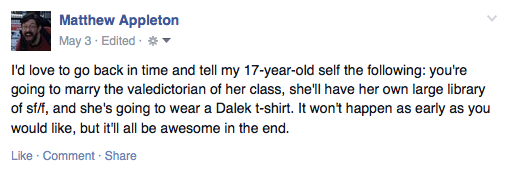
I experienced a very small taste of what this might be like when I made this post to Facebook earlier this year:
 For added measure, I quickly appended the following comment:

When I made that post, it was intended as a love note to my wife, Sally. I wasn’t reflecting on the angst and ostracism I experienced throughout my teens so much as I was expressing amazement at the way Sally possessed so many different elements I never thought I’d find in a woman who would love me. While the post explicitly referenced some of my younger self’s interests, I left unsaid other aspects of both that and my current incarnation. Most notably, my proprietary blend of social awkwardness, geeky tendencies, intellectual pursuits, off-kilter mannerisms, and occasional intentional goofiness. Unbeknownst to probably everyone who read it, the end of the original post contained subtext referencing a difficult period in my life that happened much closer to the present than my teen years. Much to my surprise, it garnered 40 Likes – which by itself almost awed me, given that on an exceedingly good day the most Likes a post of mine will receive is somewhere around a couple dozen.
A couple weeks later, I received a Facebook message that simultaneously honored and humbled me. A friend from high school had read the post to her exceptionally bright teenage son in an effort to alleviate the loneliness and sadness that he was experiencing and had most recently manifested itself in being unable to find a date for the 8th grade prom. It seemed to have helped him, and she wanted to know if I could write a couple paragraphs for him to let him know that things would eventually get better for him. Without a second thought, I agreed to do so and even promised to have something within a couple days.
But, as I started contemplating what to write, the enormity slammed into me like the Enterprise-D plowing into Veridian III. As I previously stated, the original post was a love note to Sally, and when writing it I only superficially reflected upon what it was like for me at 17. The fact is that I rarely think about my teen years anymore. It was a sad, frustrating, frequently lonely time, and properly revisiting it is somewhat unsettling. Additionally, although I agreed to do this for my friend’s son, it was impossible for me to not think of my own son, Brandon, as I attempted to compose this item. He too is a very bright child, and he didn’t merely inherit some of my difficulties with social moirés. Brandon was diagnosed with high-functioning autism early in elementary school and has already encountered all sorts of difficult challenges while navigating the neurotypical world.
I don’t know whether Mary Shelly, as she wrote Frankenstein, imagined anyone outside of her social circle having any interest in the final product, but I knew almost immediately I was writing for an audience larger than my Facebook friend’s son. I was writing for my son and all other adolescents and young adults struggling with the world. Just as importantly, I was writing for the 13-year-old who still resides somewhere deep within me and never properly found his voice.
While making all these connections, I realized that I what I needed to say would take more than just a couple paragraphs and that I unexpectedly created a Frankenstein monster of my own. After recognizing that, I started, edited, scrapped, rewrote, and completely restarted anew numerous times. However, I never found something that made me happy. I just couldn’t compose anything I truly liked better, so as a solution to this problem, I decided to use the indecision to properly harness my difficulties to my advantage. The italic paragraphs of “I Know Your Pain” really were my first few attempts at writing an introduction, and by piecing them together I felt that I tapped into the kind quick-turning tangential thinking that both plagued me as a teen and still gives me issues today.
Every writer will tell you that writing is work, but that piece rated higher on the difficulty scale than most of what I’ve composed over the years. At the same time, I experienced an enormous sense of satisfaction as I watched certain portions of “I Know Your Pain” appear on my screen. I’m not certain, but I can’t help but feel that was partially the result of my inner 13-year-old finally finding his voice. Because of that, I’m especially pleased with the final result. I don’t know if it’s my best work, but at this moment, just a few days removed from initially posting it, I already feel as though “I Know Your Pain” is one of my favorite essays.
 The Road to Mooseville
Recent Comments